This article is featured in the Winter 2025 issue of LAND magazine. Click here to find out more.
The REALTORS® Land Institute (RLI) long known as “the Voice of the Land” just keeps getting louder—and more influential.
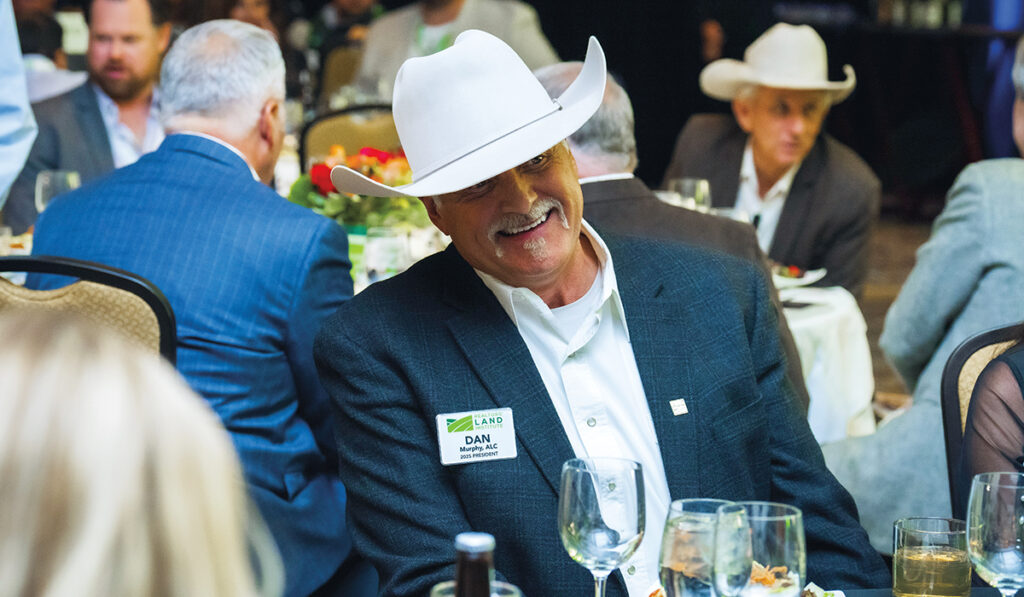
“RLI is the recognized voice of the land,” said Dan Murphy, ALC, a partner at M4 Ranch Group in Colorado and outgoing President of RLI. “Through our affiliation with the National Association of REALTORS® (NAR), the world’s largest trade association and advocate for private property rights, we have access to a powerful tool—and a seat at the tables where decisions are being made.”
While the membership is just under 2,000 land brokers, those members are some of the industry’s best educated, most productive and well-informed. As an example, the 255 member applicants to RLI’s annual APEX Production Awards in 2024 represented volume production of $8.9 billion and 1,279 million acres sold.
“At RLI, we’re small, but mighty,” Murphy said. “Because we focus on professionalism and education, we strive to be better not necessarily bigger.”
The combination of professionalism and common sense exhibited by RLI’s leaders, volunteers and staff has earned respect not only of national leaders and policymakers, but of the broader real estate industry. RLI, founded in 1944, is one of NAR’s eight affiliate organizations; the others represent commercial, office/industrial, residential, property management and female real estate professionals.
“Land is underneath all things real estate,” said Murphy, noting that the other segments of the industry have come to recognize this and become interested in issues such as water rights and mitigation that used to be of concern only to rural real estate brokers. “Now, we get questions from NAR’s directors and lobby team such as ‘What land issues do we need to be aware of?’
“We’re a valuable resource because unlike their industries, which are ‘box on box’, ours is out of the box every day—and we’ve been dealing with the ramifications of things like the Endangered Species Act and the Waters of the US rule under the Clean Water Act for decades now.”
“From our perspective, all the eight affiliate organizations exist to put top-notch, ethical professionals in the field,” Murphy said. “We believe in holding all members accountable under the umbrella of professionalism. Everything else is irrelevant.”
Change is rippling through the larger organization.
Professionalism Through Education
Just as land is the foundation of real estate, education is the foundation of RLI.
“The only way anyone is going to get better in the land industry, or any industry for that matter, is through education,” Murphy said. “RLI has dedicated itself to education. It is the basis of everything.”
Land brokers who earn the Accredited Land Consultant (ALC) designation have reached the pinnacle of professional education. To be named an ALC requires rigorous education, proven volume, attendance at a National Land Conference, letters of recommendation, and a portfolio.
The air is rarified. Of the almost 2,000 RLI members, only 765 have earned the distinction of ALC.
“Just being a member of RLI puts you way ahead of the curve, but being an ALC puts you in an entirely different category,” said Murphy, who earned his ALC designation in 2017, RLI supports its cadre of ALCs by educating the public about the value of using an ALC, providing custom resources for ALCs to use in their own marketing, hosting a biennial, three-day ALC Retreat, and presenting the ALC-to-ALC Networking Award.
RLI’s education, including the ALC courses, is delivered through LANDU. The programming includes Education Bootcamps, monthly webinars and quarterly roundtables.
“The biggest challenge for RLI right now is how fast the marketplace is changing and how fast education needs to change to keep up with it,” said Murphy, noting that RLI has recently partnered with a new curriculum design company Hiveologie to revamp the LANDU courses.
He cited the emergence of AI as a prime example of the fast-paced change.
“Many people take what AI serves up at face value, assuming its correct, when a lot of it is based on information that was wrong to begin with,” he said. “It’s important to have people go back, check and learn. If they know their industry, they’ll spot those things, but if they don’t, they could run into trouble.”
Because RLI’s members are bound by a shared commitment to learning, ethics and excellence, the opportunities for networking and collaboration are exceptional.
“In RLI, you’re dealing with people who understand what you’re working with and hold themselves to higher standards, constantly push to know more and do more,” Murphy said. “Those connections through referrals, new ideas, constructive criticism and special skill sets are absolutely monumental—and not available anywhere else on this scale.”
Since Murphy joined RLI, the membership has skewed younger in recent years. He characterizes the next generation of brokers as “sharp and aggressive about wanting to be better.” Their enthusiasm and innovation inspires him and the others in leadership to ask, “How can we give these young brokers the tools to be great in the industry?”
The answer is not written in the sky, but on
the ground.
“Our job is to give them historical context and share the wisdom of our experience, so they can find common sense solutions that address the needs of the land and landowners—and continue to speak up on behalf of both,” Murphy said. “Through multiple depressions, world wars and things that would have destroyed other organizations, RLI has never forgotten—under all things is the land—and that will not change.”
Making Noise in Washington D.C.

RRLI’s member-driven Government Affairs Committee, working in conjunction with NAR’s well-respected advocacy experts, is an influential voice on behalf of the land and private landowners throughout the nation’s capital. Their work is directed by the organization’s four pillars of advocacy: (1) protecting private property rights; (2) reducing regulatory burdens; (3) protecting beneficial tax structures; and (4) encouraging property and economic development.
To enhance their efforts, the committee created RLI’s first-ever Land Advocacy Policy in 2024. The policy outlines positions on 15 issues specific to land real estate, which guides RLI’s engagement with lawmakers and regulators on issues that impact real estate professionals and landowners.
As part of its effort to reduce regulatory burdens and enhance conservation, RLI submitted comments to the Bureau of Land Management encouraging the agency to rescind the 2024 Conservation and Landscape Health Rule. This rule identifies conservation, a non-use, as a productive use for leases and permits, which is contrary to the BLM’s authority. In application, the onerous regulation undermines the effective management of public lands.
RLI’s reach extends beyond Congress and the federal agencies to the judicial branch. In 2024, RLI and NAR submitted an amicus or “friend of the court” brief supporting private property rights in Sheetz v. County of El Dorado, California. Ultimately, the U.S. Supreme Court unanimously decided in favor of the California property owner in this land use extraction case, determining the government cannot demand hefty development fees from property owners as a condition for building permits.
In 2023, the U.S. Supreme Court handed private landowners another victory in Sackett v. EPA. Two Idaho landowners fought the EPA’s attempt to prevent them from developing their lot located near a lake. The EPA argued, the land was a protected wetland under the Clean Water Act. The Court disagreed. The ruling prompted the EPA to revise the Waters of the U.S. rule under the Clean Water Act to be clearer and conform with the Sackett ruling, reducing regulatory burdens and costs for landowners.
In May 2025, RLI participated in EPA listening sessions to help move the more beneficial rule forward. The EPA used these listening sessions as a input to a revised rule proposal announced in mid-November and promises a “clear, common-sense, durable definition” of the Waters of the U.S.
RLI also submitted an amicus brief to the Tennessee Court of Appeals in 2024 when it was considering Rainwaters v. TWRA, an Open Fields case.
Understanding that a carrot is more effective than a stick, RLI, in 2025, adopted a policy supporting financial and other incentives for voluntary private land conservation. RLI encouraged NAR, a much larger organization, to adopt the same policy, amplifying the voice of the land. On November 15, NAR’s executive committee formally adopted the policy as proposed by RLI.
Producing Results
In 2017, RLI started the APEX Production Awards, designed to recognize RLI members’ excellence and performance as well as the breadth and depth of the land real estate industry. Each year, RLI recognizes the top performing broker in eight distinct land categories as well as the Top 20 National Producers and one Top National Producer. For the 2024 APEX Awards program, there were 255 applicants with volume production of $8.9 billion and 1,279 million acres of land sold. All applicants with qualifying volume are part of the APEX Producers Club.
Mark Your Calendars
20th Annual National Land Conference
March 15–18, 2026, San Antonio, Texas
Click here to register.